
“I could not live without CELUS at this point. Just buy it. That is my two-cent answer.”
That is how Elizabeth Berney, Head of Collection Services at the University of Maine, began when a fellow librarian asked about her experience with CELUS.
And she has a particularly useful perspective: before bringing CELUS to the University of Maine, Elizabeth had already used the platform at Kansas State University, an early CELUS adopter. Having seen the difference it made there, she made sure she had approval to purchase CELUS before accepting her new role in Maine.
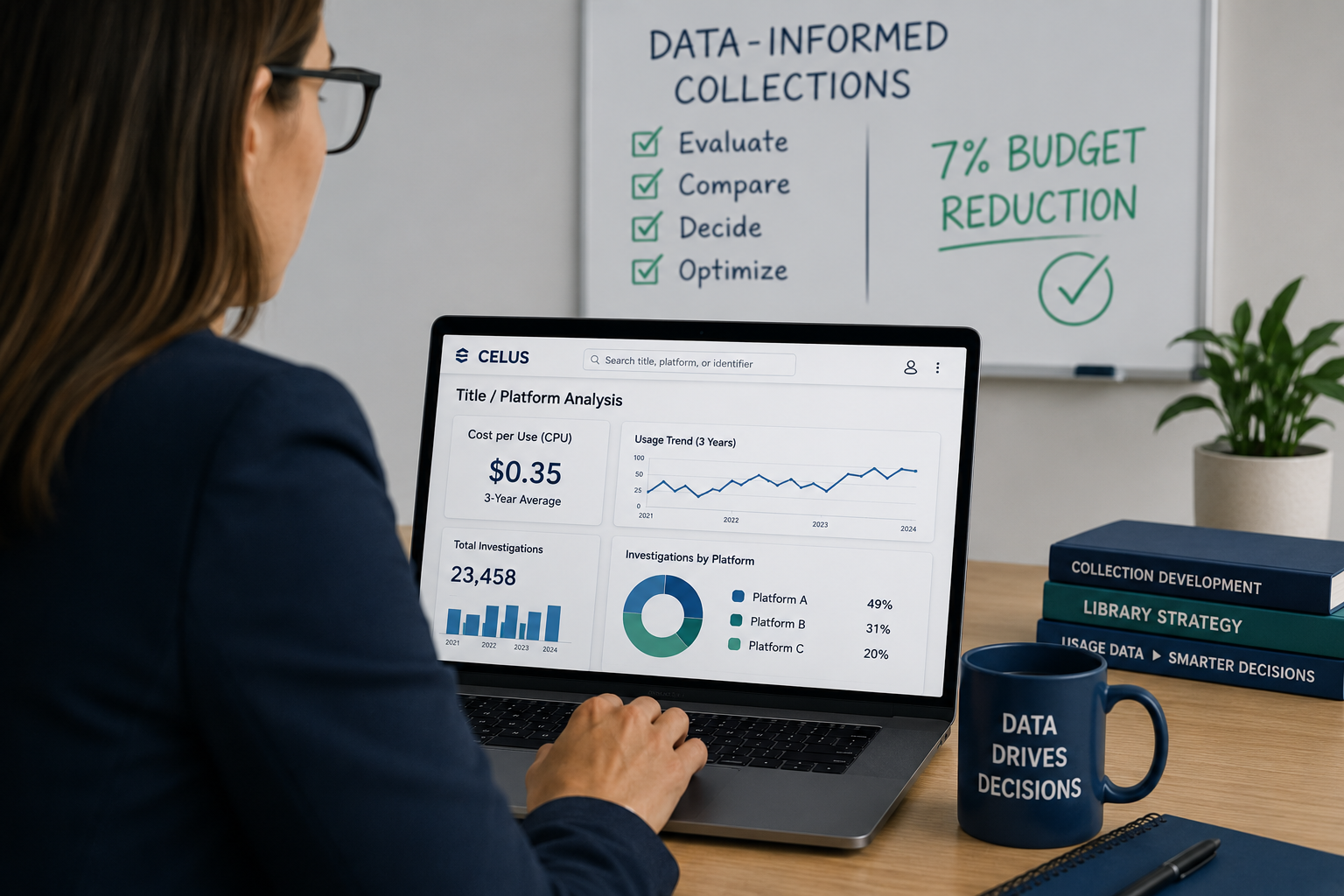
Before CELUS, analyzing e-resource usage meant downloading years of COUNTER reports from individual vendor websites, cleaning and combining the data in Excel, calculating cost per use, and then performing the actual analysis.
It worked—but it took time.
At Kansas State University, CELUS immediately changed that workflow.
“It instantly took tasks that took hours into as little as 20 minutes to create usable statistics.”
One of the features Elizabeth found particularly valuable was the ability to see usage for a single title across every platform where the library holds it. Instead of piecing the information together manually, librarians can compare usage side by side.
That became especially useful during major collection decisions, including the cancellation of a Wiley package.
When Elizabeth joined the University of Maine, she wasted little time getting CELUS up and running. Within three weeks, the team had begun adding the university’s e-resources.
The implementation also demonstrated that working with SUSHI does not need to require years of specialist experience.
Jeremy, the staff member responsible for serials, had previously worked primarily with print resources and had never configured SUSHI before. Nevertheless, he was able to add the university’s SUSHI credentials to CELUS within two weeks.
“He had never done SUSHI before and added everything just fine to CELUS. It is pretty easy once you do a few.”
Since then, the University of Maine team has worked closely with CELUS to expand the setup across all seven University of Maine System libraries.
Each university can collect and analyze its own usage while the system can also understand usage of resources shared across institutions.
For Elizabeth, that has implications beyond simply making reporting faster.
“To me it helps create a culture of data in the state of Maine which didn’t have one at all.”
As the University of Maine System expanded its use of CELUS, its staff worked directly with the CELUS team to tailor the setup to their needs.
Elizabeth describes the collaboration as straightforward and responsive, whether that means discussing requirements over email or jumping onto a call.
“They are always happy to jump on a Zoom call to help out or go back and forth via email.”
The collaboration has gone beyond implementation. The University of Maine team has also been contributing feedback to CELUS development, including functionality for incorporating local cost information and making cost-per-use analysis even faster.
The biggest difference, however, comes when usage data needs to become a decision.
For Elizabeth, CELUS is particularly valuable when conversations about subscriptions involve faculty members or university leadership.
“It is highly useful when dealing with faculty or deans who say they ‘must have’ or a title is crucial. Within two seconds of typing you can see just how useful the title really is.”
Instead of beginning a new analysis every time a question comes up, much of the information is already available.
Elizabeth estimates that CELUS has reduced the time she spends creating data analysis by as much as 90%.
That leaves more time for the work the data is supposed to support: evaluating collections, identifying duplication, carrying out large-scale weeding projects, and making informed budget decisions.
The value of that became particularly clear when Elizabeth’s dean gave her two weeks to identify a 7% reduction in the library’s 2027 budget.
With usage information already organized and accessible in CELUS, the task was dramatically easier than it would have been with her previous Excel-based workflow.
“When my dean gave me two weeks to tell her what I would cut for a 7% decrease, it was actually easy.”
And that is ultimately how Elizabeth thinks about the cost of CELUS.
“For the cost of ONE decent journal you will have time and the capabilities to cancel something you own on multiple platforms to cover the cost. CELUS is worth every single penny.”
There is one thing Elizabeth recommends to institutions beginning their CELUS implementation: import as much historical usage data as possible.
The University of Maine initially started with the default amount of historical data and soon found that it wanted a longer view.
Her recommendation is at least three years.
Having several years available makes it much easier to identify trends and distinguish meaningful changes from short-term fluctuations—especially when making collection and budget decisions.
That answer is probably clear by now.
Elizabeth has repeatedly recommended CELUS to other academic libraries and has spoken about the platform at library conferences. After she mentioned CELUS during a collections meeting with other Maine institutions, three subsequently explored CELUS trials.
Her experience spans different institutions, teams, and stages of implementation. But her conclusion remains remarkably simple:
“I have repeatedly recommended CELUS.”
Or, in the words she started with:
“I could not live without CELUS at this point. Just buy it.”