LIVE WEBINAR - FREE

Cost per use you can
actually defend

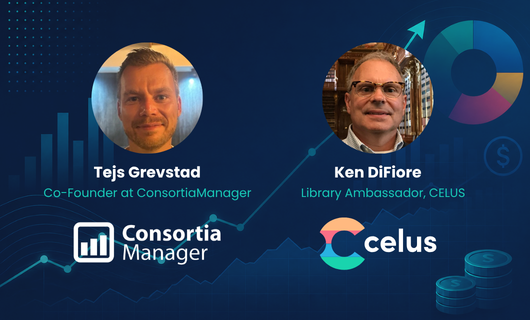
Automating usage data and building a cost per use you can stand behind — by CELUS & ConsortiaManager.

calendar_month
DATE
September 24, 2026
schedule
TIMES
9 AM & 8 PM CEST
present_to_all
FORMAT
50 min + 10 min Q&A
videocam
LOCATION
Online via ZOOM

Budgets are flat. Prices aren't. And sooner or later, someone asks the direct question: what are we renewing, and what are we letting go?

Answering that properly means knowing what each resource costs you per use. Most librarians can produce that number for one or two agreements. Far fewer can produce it consistently across a whole portfolio - and a cost-per-use figure you can't compare against anything else doesn't help you decide.
The problem isn't the formula. It's the data behind it.
Usage is spread across publisher platforms, SUSHI feeds, emails, downloaded reports and spreadsheets. Some of your most expensive resources may not support COUNTER at all. Even with the usage in hand, you still need to know what the agreement actually included, which period and cost to use, and which metric makes sense.

In this practical session, CELUS and ConsortiaManager show how to bring those pieces together and build cost-per-use figures you can defend in front your director, finance office or faculty comittee.

What you'll learn

check
The three questions that decide if your number survives scrutiny
What was actually in the package, what was actually used, and which metric you counted.
check
From single agreements to your whole portfolio
Make cost per use a decision-making tool instead of an isolated figure.
check
Include resources that don't support COUNTER
Legal databases, news archives, standards, streaming services and local-language publishers.
check
Why agreement data matters as much as usage data
Scope, subscription period and the titles actually covered by the price.
check
How to spot zero-use and underused content
And tell a collection decision apart from a potential access problem.
check
Why one year of usage needs more context than it used to
AI-assisted discovery, bot traffic, platform changes and the COUNTER 5.1 transition.
We'll take a real agreement from price and scope through usage to title-level cost per use — including both COUNTER and non-COUNTER data — and show what the resulting numbers can tell you.

Who should attend

E-resources, acquisitions and collection development librarians — and anyone responsible for evaluating or defending a collections budget.You don't need to use CELUS or ConsortiaManager to attend. The principles apply whether you work with dedicated tools, spreadsheets, or a mix of both.